How long does a solar generator last? It depends on which question you mean. Some people ask about hours on one charge. Others want to know how many years the unit will keep working.
Both answers are below, plus the math behind them and the habits that add years to the battery.
What a Solar Generator Actually Is
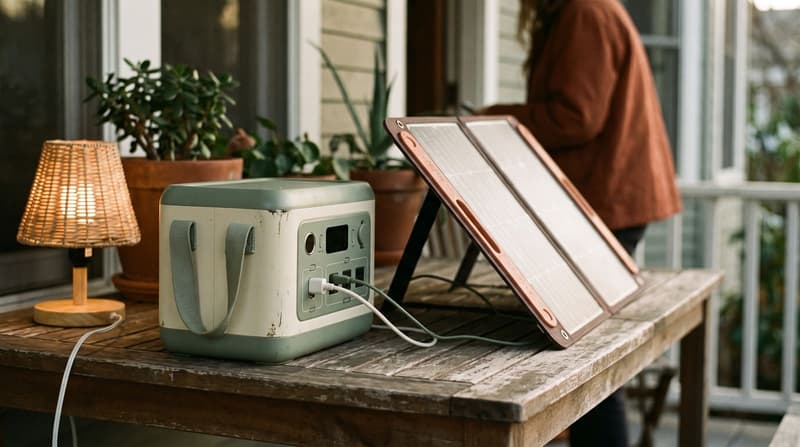
Is it a generator at all? Not really. It is a battery in a box with outlets on the front. A folding solar panel plugs in and refills it.
Sellers also call it a portable power station. There is no engine, no gas and no exhaust. That is why it can sit on your kitchen counter while a gas generator cannot.
Two numbers on the box matter most:
- Watt-hours (Wh). How much power the battery holds. This sets your run time.
- Watts (W). How much it can push out at once. This sets what you can plug in.
A 1,000 Wh unit holds about one kilowatt-hour. That is close to what a fridge uses in a day.
How Long Does a Solar Generator Last on One Charge
Here is the napkin math. Take the watt-hours, divide by the watts your device pulls, then cut the answer by about 15 percent for heat and losses.
Watt-hours divided by watts equals rough hours.
So a 1,000 Wh unit with a 60 W laptop gives about 16 hours on paper. Call it 14 real hours.
The numbers below are rough, based on a 1,000 Wh unit. Check the label on your own gear, since every model differs.
| What you plug in | Rough watts | Rough hours |
|---|---|---|
| Phone charger | 10 | 80 or more |
| LED lamp | 10 | 80 or more |
| Laptop | 60 | 14 |
| CPAP with no heater | 40 | 20 |
| Box fan | 75 | 11 |
| Full-size fridge | 100 average | 8 to 12 |
| Microwave | 1,000 | under 1 |
| Space heater | 1,500 | too big for most units |
How long will it run a refrigerator?
A fridge does not run all the time. It kicks on, cools down, then rests. Over a full day it uses far less than the label suggests.
That is why a 1,000 Wh unit often keeps a full-size fridge going 8 to 12 hours. A 2,000 Wh unit can cover about a day. Both are estimates. A packed fridge in a cool room beats an empty one in a hot garage.
Do not open the door to check on it. FEMA Ready.gov says a closed fridge keeps food cold for about 4 hours on its own, and a full freezer holds for about 48 hours. Our guide to power outage food safety covers what to keep and what to toss.
Can you run it non-stop?
Only if the sun keeps up with the draw. Say your panel makes 200 W on a clear day and your gear pulls 100 W. You gain ground. Flip those numbers and the battery still drains, just slower.
Clouds, short winter days and a panel lying flat all cut the input. Many people see about half the rated panel watts in real life. Plan for that, not for the best day of the year.
Can you use a solar generator every day?
Yes. The makers build for it. Daily use does age the battery faster than sitting in a closet, so pick a size that does not run flat every night.
How Many Years Will It Last?
Now the second question: how long does a solar generator last in years? Battery life gets counted in cycles, not months. One cycle is one full charge plus one full drain.
These cycle counts are rough, based on what makers publish:
| Battery type | Rough cycles | Rough years of daily use |
|---|---|---|
| Older lithium-ion | 500 to 800 | 3 to 5 |
| Lithium iron phosphate | 3,000 to 6,000 | 10 or more |
Lithium iron phosphate is the longer-lasting kind of cell, often printed on the box as LiFePO4 or LFP. Most newer units use it. If the listing does not say, ask before you buy.
At the end of those cycles the pack still works. It just holds less than it did new.
What about the panel? Panels outlast the battery by a wide margin. The U.S. Department of Energy says most solar systems keep at least 80 percent of their starting output for at least 25 years, and drop only about 1 percent a year.
What wears one out fastest?
Four things do most of the damage:
- Heat. A hot car or a sunny shed is hard on cells.
- Sitting full. Months parked at 100 percent ages the pack.
- Deep drains. Running to zero again and again counts against you.
- Cold charging. The U.S. Fire Administration says not to charge lithium-ion batteries below 32°F or above 105°F.
What Is the Downside of a Solar Generator?
Three honest drawbacks:
It costs more up front. A 1,000 Wh unit with a panel often lands between $700 and $1,500. That is a rough range, and sales move it a lot. A gas generator with the same output costs much less.
It refills slowly. Sun is not a gas can. Two gray days in a row can leave you short.
It cannot run big electric loads. Well pumps, electric ranges, electric water heaters and central air all pull more than most units can give.
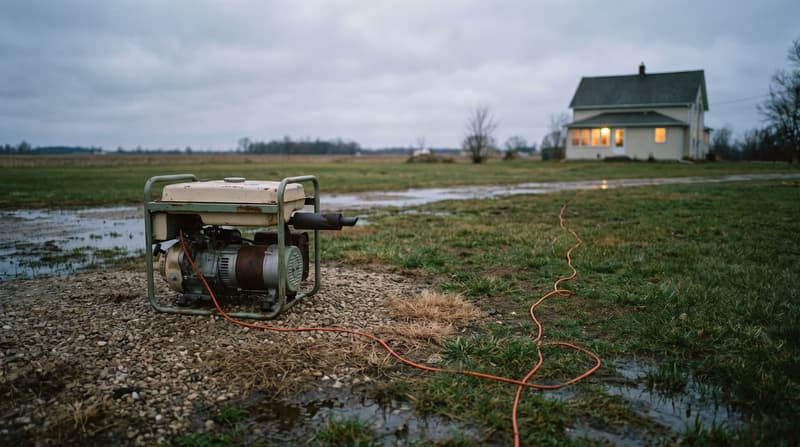
So what does it do better? Safety. A gas engine makes carbon monoxide, a gas you cannot see or smell. FEMA Ready.gov says generators and fuel must be used outdoors, at least 20 feet from windows, doors and attached garages. A solar generator has no exhaust, so it can run right beside your bed.
If you own a gas unit too, read our portable generator safety rules before the next storm. For anything wired into the house, hire a licensed electrician.
Make Yours Last Longer
Run through this list twice a year:
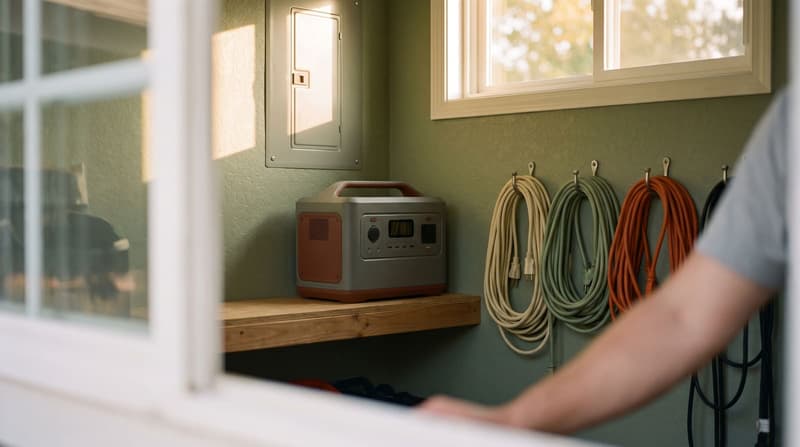
- Store it indoors at room temperature, as the U.S. Fire Administration advises
- Leave it near half charge for long storage, not full and not empty
- Top it off every 3 to 6 months
- Stop using it if you see swelling, leaks, odd smells, odd noises or too much heat
- Wipe the panel clean and tilt it toward the sun
- Test it for real: unplug the fridge from the wall and run it off the unit for an hour
- Write the date of that test on a strip of tape
That last test is the one people skip. Do it once and you will know your true run time instead of guessing at it.
Size It for the Outage You Expect
How do you pick a size? Add up the watts of what you truly need, then match that to the hours you want.
- Phones, lights and a radio only. 300 to 500 Wh is plenty.
- Add a fridge for a day. Look at 1,500 to 2,000 Wh plus about 200 W of panel.
- Medical gear. Ask your doctor or your equipment supplier what your device needs and for how long. Ready.gov tells people with power-dependent medical devices to make a plan ahead of time. Call your power company too, since many keep a list of medical customers.
The real answer to how long does a solar generator last comes from your own list, not from a sales page.
A power station is one piece of a bigger kit. Pair it with the basics on our 72-hour home emergency checklist. Store water as well, since plenty of homes lose pressure in an outage. See how much water to store for an emergency for amounts by household size.
Everyone at home should know where the unit lives and how to plug it in. Our family emergency plan guide covers who does what.
Your Next Step
Find the watt-hour number on the unit you own or want. Divide it by the watts of the one thing you must keep running. Write that number of hours on a piece of tape and stick it on the case.