Want to know how to store water long term without it turning into a science project? The short version is simple. Use clean food-grade containers, fill them with safe tap water, keep them cool and dark, and check them on a schedule.
That is it. The rest of this guide shows each step, so the water you put away today is still good when you need it. The steps come from the CDC, Utah State University (USU) Extension and FEMA Ready.gov.
How Much Water Should You Store?
Start with the goal. FEMA Ready.gov says to store at least one gallon per person per day. Plan for 3 days at the least, and 2 weeks if you can.
For a family of four, 2 weeks is 56 gallons. Our guide on how much water to store for an emergency has a full table by family size.
Pick the Right Containers
What should you keep the water in? This choice matters more than anything else.
The CDC says the best pick is a food-grade water storage container. If you use something else, it should close tight and be made of a strong material that will not break. The CDC says that means not glass. It also says never use a container that once held bleach, bug spray or other chemicals.
USU Extension adds that the best containers have a secure lid and a spout or spigot. It also warns that very thin plastic can split over time.
| Container | Holds | Rough cost | Good for | Watch out for |
|---|---|---|---|---|
| Sealed store-bought bottles | 0.5 to 1 gallon | A few dollars a case | Grab and go | Use by the date on the label |
| Food-grade jugs with spigot | 5 to 7 gallons | Rough estimate $15 to $30 | Daily use in an outage | Heavy when full, about 40 to 58 lbs |
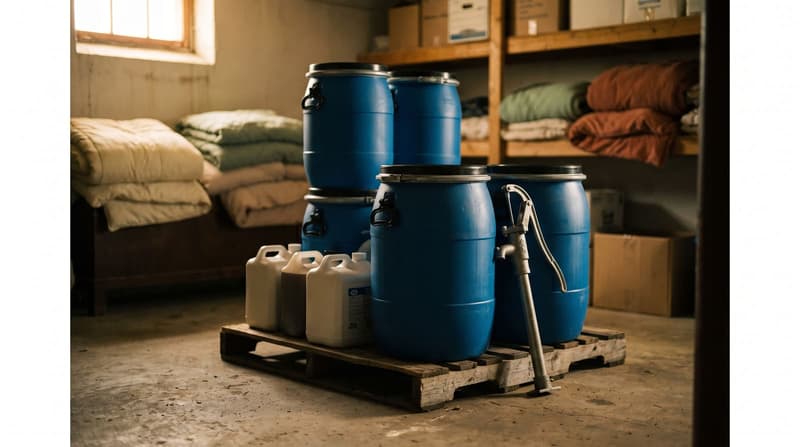
| Food-grade barrels | 30 to 55 gallons | Rough estimate $60 to $120 | Big family supply | Needs a pump, too heavy to move once full |
| Clean soda bottles | 2 liters | Free | Filling gaps | Thin plastic, rotate often |
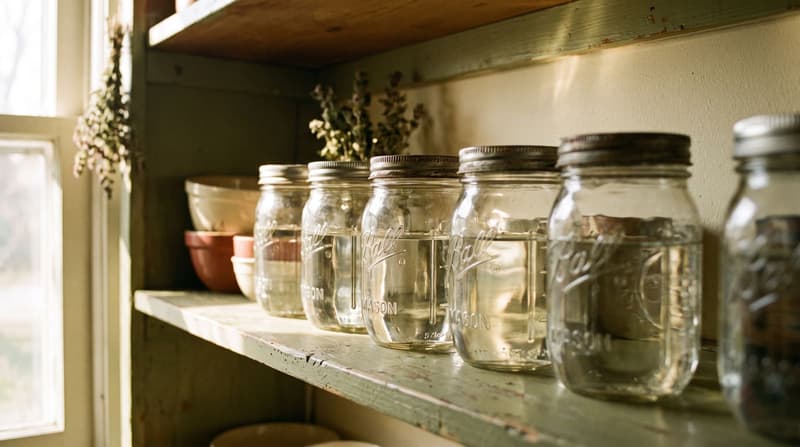
| Glass canning jars | 1 quart | Already own them | Backup only | Can break |
Prices are rough estimates and change by store and area.
How to store water long term without plastic
Can you skip plastic? Yes. USU Extension says stainless steel works. Glass jars work too, but only as a backup because they break. Our guide on storing water in mason jars shows how to can water so it seals tight.
How to Store Water Long Term in a Container, Step by Step
Here is the full process. It works for jugs, barrels and bottles.
1. Wash the container
Wash it with dish soap and water. Then rinse it well.
2. Sanitize it
The CDC says to mix 1 teaspoon of plain, unscented bleach in 1 quart of water. Pour it in, close the lid and shake so it touches every inside surface. Let it sit at least 30 seconds. Pour it out and let the container air dry.
3. Fill it with safe water
Use tap water you already drink every day. If you are not sure it is safe, treat it before you store it.
4. Treat it for long storage (optional)
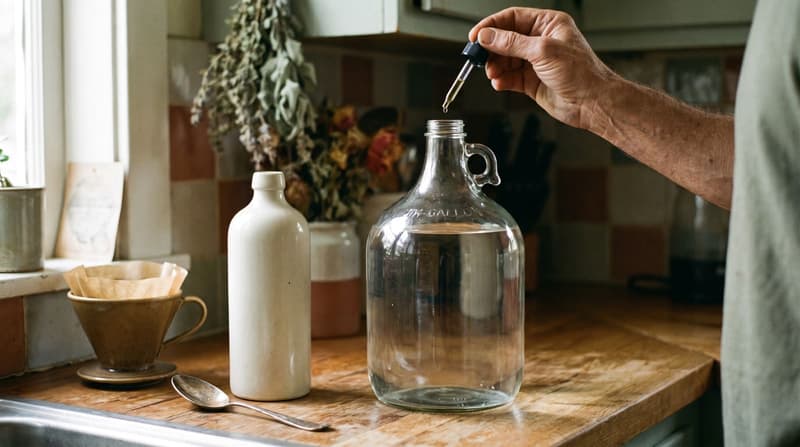
Do you need to add bleach to tap water? City water already has a little chlorine in it. For longer storage, USU Extension says you can add 1/8 teaspoon of unscented bleach (4 to 6% strength) per gallon.
Use fresh bleach. USU says bleach can lose up to half its strength after 6 months. Never add more “to be safe.” Too much can make you sick. Our guide on how to purify water with bleach has the exact drops for each strength.
5. Seal and label
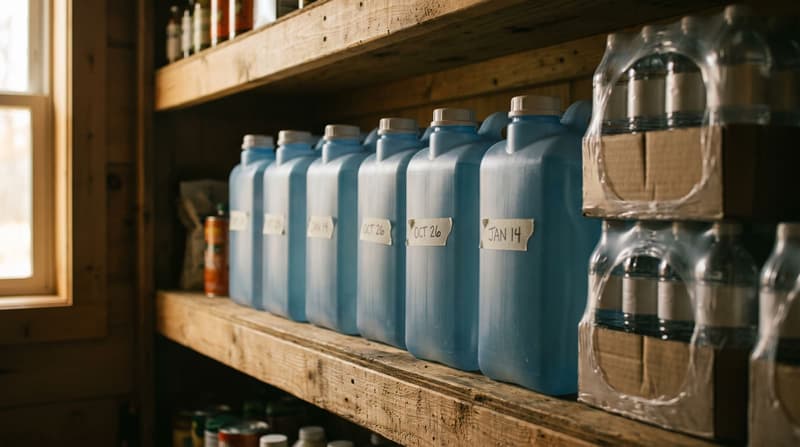
Close the lid tight. Write “drinking water” and the date on a strip of tape. Add the date it is due to be checked.
Where to Keep Stored Water
Where does it go? The CDC says to keep water somewhere cool, about 50°F to 70°F, and out of direct sun. Keep it away from gasoline, paint and bug spray, since fumes can pass through plastic.
USU Extension says to keep it clean, dry and off the ground. A wooden pallet under a barrel, like the one in the photo above, does the job. Good spots include:
- A basement corner
- An inside closet
- Under beds
- A pantry floor
Can you store water in the garage? Only if it stays cool and far from fuel and chemicals. In most homes, a garage gets too hot in summer and too cold in winter.
How to store water long term in the freezer
Got freezer space? USU Extension says frozen water is a fine choice. Leave 2 to 3 inches of space at the top so the container does not split as the water grows. Frozen jugs also help keep food cold if the power goes out.
How Long Can Water Be Stored and Still Be Drinkable?
This is where the experts give two answers, and both are useful.
USU Extension says water that was safe and stored the right way “should have an indefinite shelf life.” In plain words, water does not spoil on a set date.
The CDC and Ready.gov are more careful. They say to replace water you bottle yourself every 6 months. For store-bought water, the CDC says to check the date on the label.
So which one do you follow? Here is what we do. Rotate jugs and bottles every 6 months, since that is easy. For big barrels that are hard to empty, check them every 6 to 12 months like USU says. If the water looks cloudy, smells odd or the lid came loose, treat it or use it for plants and refill.
How to store water for 10 or 20 years
Can you really leave water for 20 years? No official source promises that. Plastic ages, lids loosen and bleach fades. A better plan is a water supply that never gets that old. Check it twice a year and rotate it.
A Twice-a-Year Check
Pick two easy dates, like when the clocks change. Then run this list:
- Look for cracks, leaks or bulging
- Make sure every lid is tight
- Look for cloudy water or anything floating
- Swap out home-filled jugs and bottles
- Check dates on store-bought water
- Buy fresh bleach if yours is over 6 months old
- Make sure your pump or spigot still works
Does dumping old water feel like a waste? Use it on the garden or to fill the washing machine. Then refill.
Your Next Step
Pick one food-grade jug this week and fill it using the 5 steps above. Label it with today’s date. Then add “check water” to your calendar for 6 months from now, and mark water off on your 72-hour home emergency checklist.